Back again with Mossy Earth on their land on the Río Tiputini, Orellana, Ecuador.

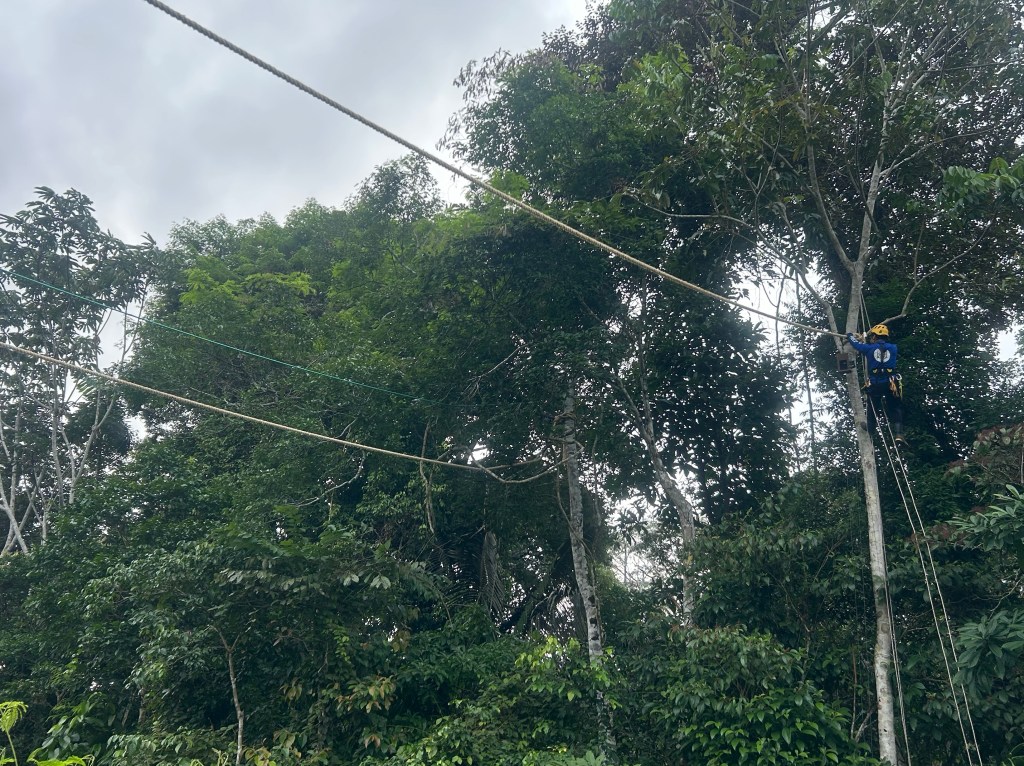
On this project the aim was to construct canopy bridges over the road, with scope to expand to the wider area in the future. The idea of these bridges is to increase canopy connectivity, allowing arboreal fauna to cross between disconnected patches of forest; over clearings and roads. Some species are reluctant to come to ground so these barriers can prove isolating, not to mention the risk of becoming roadkill.


Ollie teamed up with his apprentice Ramiro Gualinga, a student of a tree climbing course we ran in late 2024. Ramiro has taken to work at height brilliantly – a ropey scientist in the making!
The canopy bridge design will also allow for some experimentation into design preferences of the fauna using the bridges. Each bridge site consists of two bridges: one a single 25mm hemp rope and the other the same rope but with a 16mm polypropylene rope running parallel and just above the hemp one. The idea with this is that it gives animals with tails and extra support – a handrail of sorts. Two of the sites also had a wide gauge mesh suspended above them. This design we’ve come up with to simulate shade or canopy cover, something novel as far as we can tell, so we’re interested to see how visitation rates vary between the shaded and non-shaded bridges.
All the data for this study is being collected with our very own CanopyCam system. The beauty of this is that the team here can continue to monitor the fauna using the bridges long after the Ropey Science team have left. The system allows anyone to lower the camera traps left up in the trees, all from the ground. There the data can be collected and fresh batteries applied before sending the camera back ready for another round of footage!

Project Partners:


 Ropey Science